
You type your best keyword into Google. There you are in position one. Then your eye drifts up, to the AI-written summary sitting above the results, and you’re not in it. Someone else is.
That gap is new. Ranking first used to be the finish line for search visibility. Now a page can hold the top organic spot and still be left out of the answer Google shows first.
This piece looks at how loosely ranking and AI citation are actually tied together right now, and what that means for how you spend your SEO time.
TL;DR
- The link between ranking and citation is loosening fast. The share of AI Overview citations from top 10 pages fell sharply in a single year.
- Ranking first is not a guarantee. The top result has roughly a one-in-two to one-in-five chance of showing up in the AI Overview for that same search.
- AI Overviews reach further down the page than they used to. Nearly half of citations now come from pages ranking below position five.
- Coverage matters as much as rank. Pages that also answer the follow-up questions get cited far more often than pages built around one keyword.
- Domain authority carries less weight than before. Individual page quality is doing more of the work.
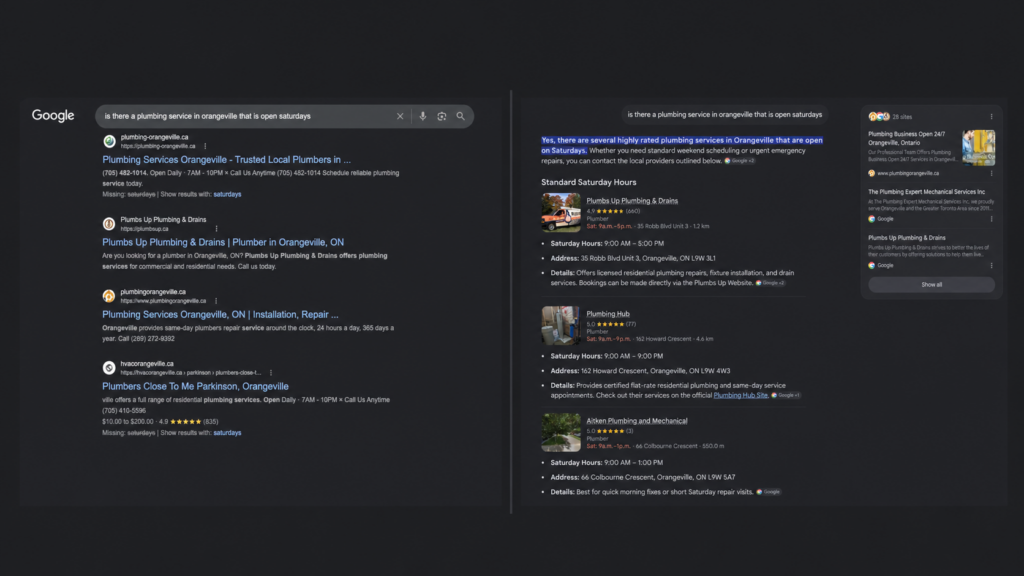
In the above image you can see that the number one Plumber-Orangville on the left, is no where to be seen in the AI Overview on the right.
What decides whether Google cites you?
When Google builds an AI Overview, it doesn’t grab the top 10 results and summarize them. It runs a step called query fan-out, it breaks your search into several related sub-questions, then goes looking for a source to answer each one.
So a page can rank perfectly for the exact phrase someone typed and still get passed over, because it never addressed the related questions Google raised behind the scenes.
Think of the old featured snippet as a single quote pulled from one top page. An AI Overview is more like a panel, Google assembles an answer from several sources at once. That’s the whole reason pages outside the top 10 can now get a seat at the table.
What the data says
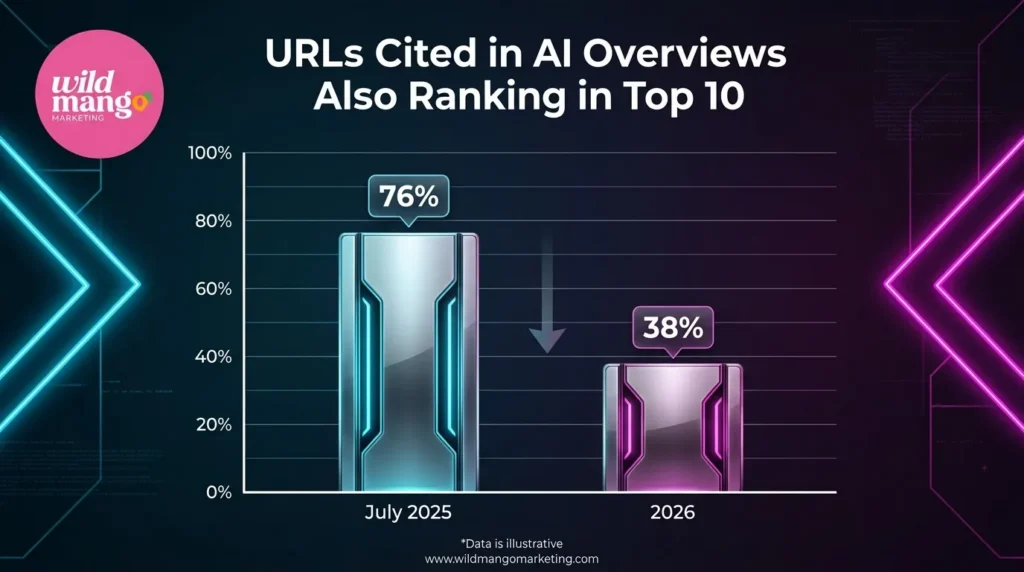
In July 2025, Ahrefs found that about 76% of the URLs cited in AI Overviews also ranked in Google’s top 10 for the same query. By 2026, across an analysis of four million AI Overview URLs, that figure had fallen to roughly 38%.
That’s a big drop in under a year. A top ranking is no longer close to a sure thing.
Separate research citing Semrush and Ahrefs data puts the odds of AI Overview inclusion for a number-one page somewhere between 17% and 54%, depending on the type of query. An estimated 47% of AI citations now come from pages ranking below position five. And the link between domain authority and AI Overview inclusion has weakened a lot compared to traditional rankings.
Read that again. Nearly half of AI citations are going to pages most owners assume are too far down to matter.
Why coverage beats a single keyword
Surfer SEO analyzed 10,000 keywords and found a strong pattern: the more of Google’s fan-out sub-questions a page ranked for, the more likely it was to be cited.
Pages that ranked for the main query and at least one related fan-out query were 161% more likely to be cited. Those pages accounted for more than half of all AI Overview citations in the study.
The takeaway is plain. A narrow article aimed at one keyword is easier to skip than a page that covers the topic from a few angles. That’s the standard we hold ourselves to when we build AI-search content for clients, full topics, not single-keyword landing pages.
What this means for your SEO strategy
Traditional SEO is still the foundation. A page has to be crawlable, well-structured, and competitive in the organic results before it has any real shot at a citation.
But rank alone isn’t enough anymore. Topic coverage, semantic completeness, and a clear answer structure now sit alongside the usual ranking factors.
Here’s the exposure. If your visibility rests on owning the top spot for one keyword, you’re wide open to a competitor who covers the whole topic. Our AEO and GEO service is built to close that gap, we map the questions AI systems fan out to before we write a word.
Action steps
- Stop treating rank as the finish line. Check whether your top-ranking pages appear in the AI Overview for the same query.
- Build topic coverage, not single-keyword pages. Answer the questions a searcher is likely to ask next.
- Strengthen page-level signals. Structure, schema, and clarity now matter more than overall domain authority.
- Test your priority queries regularly. Search your key terms and note which competitors show up in the AI Overview instead of you.
A top ranking is still worth earning. It’s just no longer the guarantee it once was. The pages that show up in AI Overviews cover a topic completely; they don’t just win one keyword.
Want to know which of your pages are getting cited and which are getting skipped? Book a free 20-minute call and we’ll tell you where we’d start.
Frequently asked questions
Does ranking #1 on Google guarantee an AI Overview citation? No. Depending on the query, a number-one ranking gives you roughly a 17% to 54% chance of appearing in the AI Overview. That’s a strong position, not a guarantee.
Why did AI Overview citations from top-10 pages drop so much? Google’s AI Overviews now pull from a wider set of sources through query fan-out, which retrieves pages for related sub-questions rather than leaning only on the top results for the original search.
Can a page ranking on page two of Google still appear in an AI Overview? Yes. An estimated 47% of AI Overview citations come from pages ranking below position five, so lower-ranking pages get cited more often than most businesses expect.
What is a fan-out query? It’s one of several related sub-questions Google’s AI generates from your original search. Google answers each one from a different source, so the Overview can draw on several angles of a topic instead of just the phrase you typed.
Should I stop focusing on traditional SEO rankings? No. Strong organic rankings are still the foundation of AI visibility. They’re just not enough on their own, topic coverage and clear answer structure now matter alongside rank.
How can I check if my top-ranking pages are being cited? Search your priority queries and note whether your page appears in the AI-written summary, not just the organic results below it. A structured AI visibility audit can track this across many queries at once.
So go back to that search. You’re still at position one, and that’s still worth having. But now look up at the summary above you, and ask a better question than “am I ranking?” Ask “am I in the answer?”
The page that gets quoted up there isn’t the one that won a single keyword. It’s the one that answered the whole question, including the parts the searcher hadn’t thought to ask yet. That’s the work now.
Someone is going to be in that box for your best terms. It might as well be you.
As always, you can contact the team at Wild Mango Marketing for all your digital marketing services.